
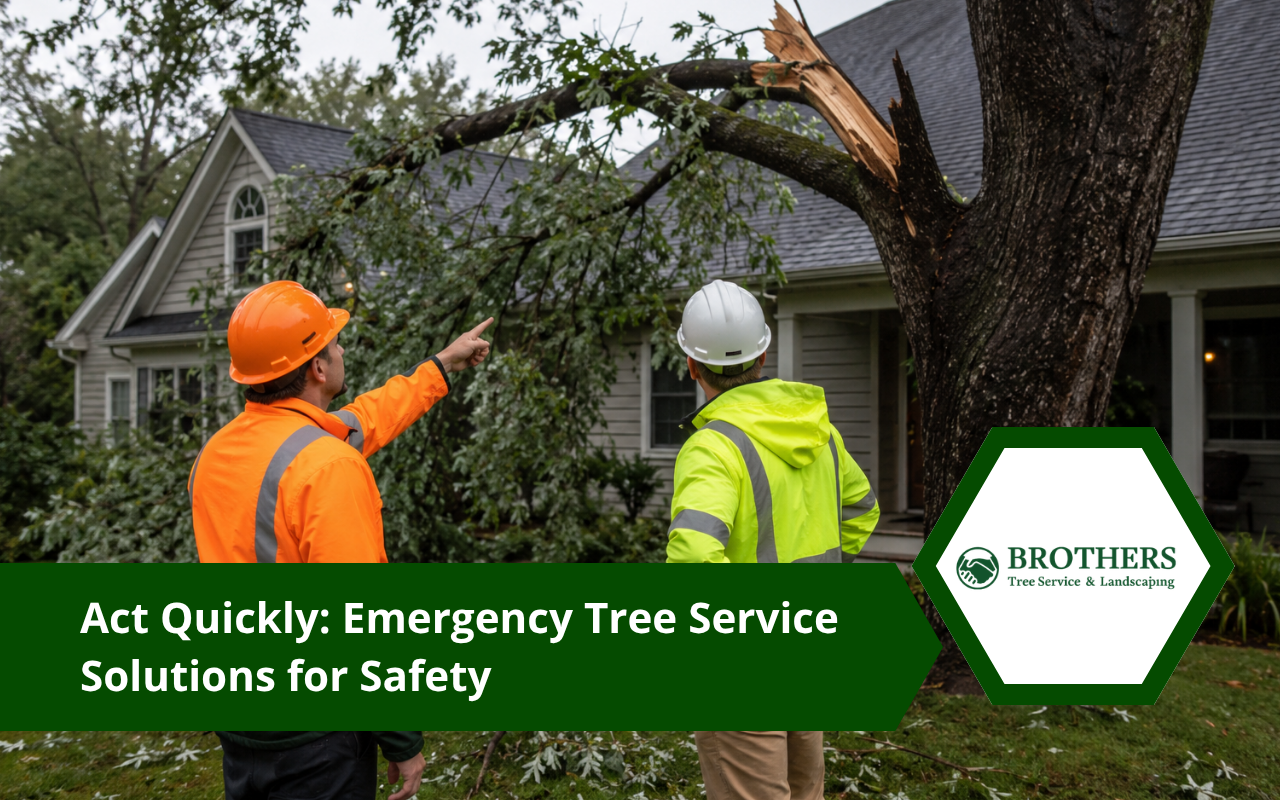
A damaged or unstable tree can threaten your home, vehicles, walkways, and family. Knowing when to request emergency tree service helps you act before a weak limb or leaning trunk causes serious harm.
At Brothers Tree Service & Landscaping, we focus on safety, clear communication, and careful hazard control. Homeowners facing an immediate risk can review our emergency tree removal options and take the next safe step without approaching the damaged area.
Spot the Signs of Immediate Tree Danger
Tree damage is not always easy to judge from the ground. A tree may look stable while hidden cracks, weak roots, or internal decay reduce its strength.
Recent storms, strong wind, heavy rain, and sudden limb failure can make these problems worse.
Emergency Tree Hazards to Watch For
- A tree is leaning toward a house, driveway, or power line.
- Large branches are cracked, split, or hanging overhead.
- The trunk has deep openings or fresh vertical cracks.
- Roots are exposed, lifted, damaged, or surrounded by soft soil.
- A major limb has already fallen without a clear cause.
- The tree moves unusually during light wind.
These emergency tree hazards require careful attention. Keep people and pets away from the area, and do not stand beneath damaged limbs to inspect them.
Take Safe Steps Before Help Arrives
When a tree becomes unstable, your first goal should be to control access to the danger zone. Do not cut, pull, climb, or move damaged branches.
Even a small shift can release trapped weight and cause a sudden fall.
What to Do First
- Move family members, pets, and vehicles away from the tree.
- Block nearby paths, doors, driveways, and outdoor work areas.
- Stay clear of branches touching utility or power lines.
- Take photos only from a safe distance.
- Call for urgent tree help and describe what you can see.
- Follow any safety directions provided by the responding team.
Our team can use your description and photos to understand the situation before arrival. Clear information supports a safer emergency tree service response.
Key Takeaway
Do not approach unstable trees or hanging limbs. Move people away, block access, and call for professional help from a safe location.
Compare Tree Hazards With the Right Next Step
Different tree emergencies need different responses. Some hazards require immediate action, while others need inspection before the next storm.
| What You Notice | Possible Risk | Best Next Step |
|---|---|---|
| Large hanging limb | The branch may fall without warning. | Keep the area clear and request urgent service. |
| Tree leaning after a storm | Roots or soil support may be failing. | Schedule an emergency evaluation. |
| Cracked trunk | The main structure may be unstable. | Avoid the area and call a tree service team. |
| Branches touching utility lines | Electrical danger may be present. | Stay away and contact the proper utility provider. |
| Tree blocking access | Driveways, exits, or walkways may be unsafe. | Request same day tree service if available. |
Understand How Professionals Control Tree Hazards
Professional crews begin by checking the tree, the surrounding property, and possible fall zones. They consider trunk damage, branch weight, root movement, nearby buildings, access points, and utility lines.
Specialized equipment may be needed to lower heavy limbs in smaller sections. Ropes, rigging systems, lifts, and cutting tools help workers manage weight and direction.
With Brothers Tree Service & Landscaping, homeowners receive a safety-first approach based on the conditions at the property. The goal is to stabilize the area and complete necessary work without creating additional risks.
Key Takeaway
Emergency tree work requires control, planning, and proper equipment. Safe removal depends on the tree’s condition, weight, lean, and surroundings.
Know When Dangerous Tree Removal Is Necessary
Not every damaged tree must be removed. Some trees can remain in place after careful pruning or limited limb removal.
However, dangerous tree removal may be necessary when the trunk is badly split, the root system is failing, or severe decay has weakened the main structure.
Removal may also be the safest option when a tree leans toward an occupied building or has multiple broken sections above a busy area. An emergency assessment can help determine whether part of the tree can be saved safely.
Never assume a standing tree is secure because it has not fallen yet. Sudden movement can occur during wind, rain, or changes in soil pressure.
Request Same Day Response After Storms and Wind
Storm damage can create immediate and delayed hazards. Some branches fall during the storm, while others remain caught in the canopy.
Same day tree service can reduce the time your property remains exposed to danger. Fast evaluation is especially important when damaged branches hang above entrances, vehicles, play areas, or sections of the home.
When you choose Brothers Tree Service & Landscaping, we assess the visible risk and plan the safest available response. Weather, access, tree size, and surrounding hazards may affect how the work is completed.
Key Takeaway
Storm-damaged trees can remain dangerous after the weather clears. Hanging limbs, leaning trunks, and blocked access should be reviewed quickly.
Prevent Future Tree Emergencies at Home
Regular observation can help you find weak trees before severe weather arrives. Preventive care cannot stop every emergency, but it can reduce avoidable risks and support healthier growth.
Tree Safety Habits
- Check trees after strong wind, heavy rain, and major storms.
- Watch for dead branches, peeling bark, cracks, and cavities.
- Keep large limbs from becoming crowded above roofs and paths.
- Look for soil movement or exposed roots near leaning trees.
- Arrange professional evaluation when changes appear suddenly.
- Avoid cutting large limbs without proper tools and training.
Early action is often safer than waiting for visible damage to become severe. A planned inspection also gives you more time to understand the condition and consider appropriate options.
Frequently Asked Questions
When should I call for emergency tree service?
Call when a tree or large branch may fall on people, buildings, vehicles, roads, or utility lines. You should also seek help after sudden leaning, trunk splitting, root lifting, or major storm damage. Our guide to storm-damaged trees explains common warning signs.
Can I remove a hanging branch myself?
No. Hanging branches can move without warning and may be under heavy pressure. Do not climb the tree, use a ladder, or stand beneath the branch. Review these tree removal safety tips before taking any action near the area.
Does every damaged tree need full removal?
No. Some trees may only need damaged branches removed. Others may require full removal because of trunk failure, root damage, decay, or an unsafe lean. A professional evaluation helps determine whether preservation is realistic and safe.
How quickly can a dangerous tree be addressed?
Response depends on the danger level, weather, access, crew availability, and equipment needed. Same day tree service may be possible for urgent situations. Details about standard and hazardous removals are available through our tree removal services.
What should I provide when searching emergency tree service near me?
Share the tree’s size, visible damage, location, nearby structures, and any contact with utility lines. Mention whether branches have fallen and whether people can safely enter or leave the property.
Get Fast Help for a Dangerous Tree
A weak tree can change quickly after wind, rain, decay, or sudden limb failure. Keep everyone away from the danger zone and seek professional help instead of trying to handle unstable wood yourself.
At Brothers Tree Service & Landscaping, we help homeowners take a clear and safety-focused next step. Use our contact page for urgent tree assistance when a damaged tree threatens your property or blocks an important area.