
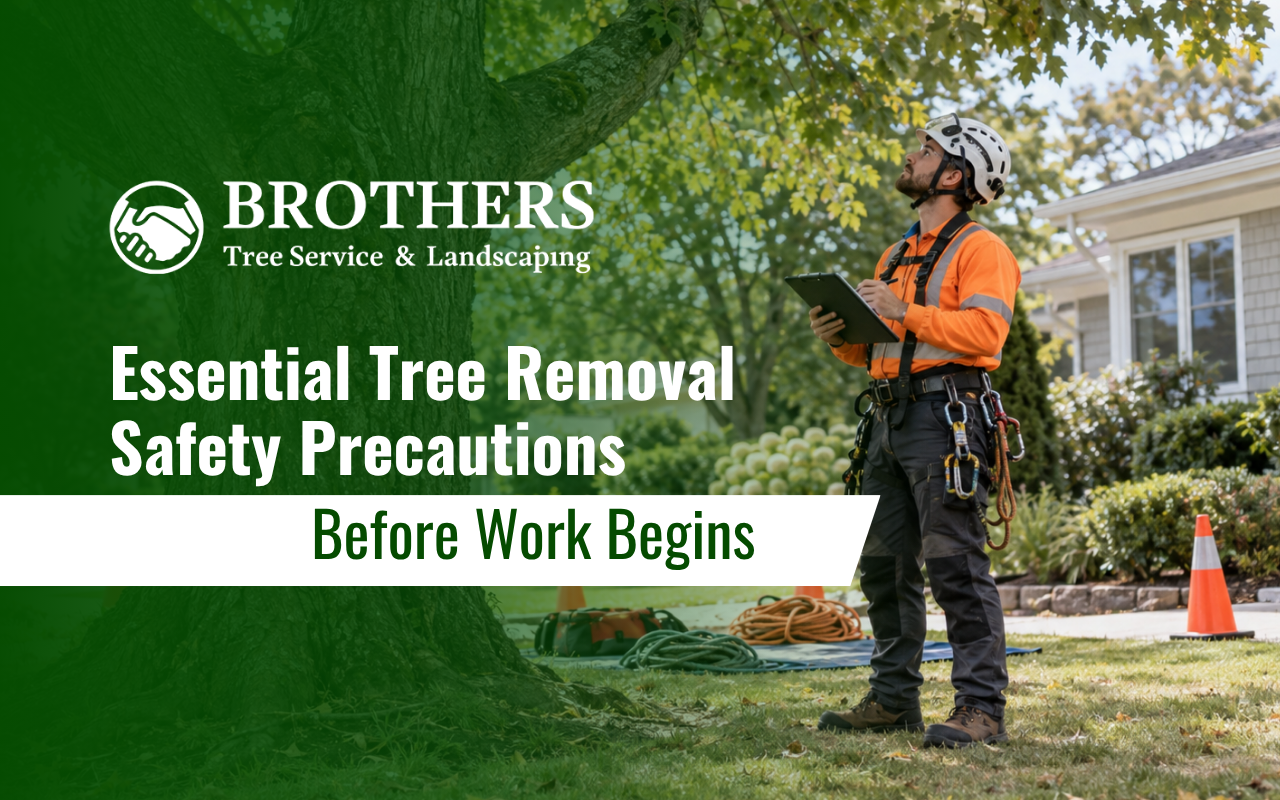
Removing a tree can expose people and property to falling branches, unstable wood, electrical lines, and heavy equipment. Tree removal safety begins with identifying these dangers before workers enter the area or start operating machinery.
This guide explains professional safety considerations without providing step-by-step cutting or felling instructions. It helps property owners recognize unsafe conditions and understand when trained workers, utility coordination, or specialized equipment becomes necessary.
At Brothers Tree Service & Landscaping, we provide careful professional tree removal for properties where tree condition, limited access, and nearby structures require detailed planning.
Common Tree Removal Hazards That Require Careful Assessment
Tree conditions can change quickly during removal. Hidden decay, weak branch attachments, damaged roots, trunk cracks, and storm damage may affect how the tree responds when work begins.
The surrounding property introduces additional risks. Buildings, vehicles, pedestrians, slopes, landscaping, and utility lines may restrict movement or reduce the space available for machinery.
- Dead, broken, hanging, or storm-damaged branches
- Visible cavities, decay, cracks, or fungal growth
- A heavy lean toward buildings or utility lines
- Damaged roots or unstable ground around the trunk
- Branches or trunks held under pressure
- Limited access for workers and equipment
What Should Be Checked Before Tree Removal Begins
A pre-removal assessment should examine the tree from its roots through the canopy. Workers also evaluate the surrounding property, overhead space, equipment access, and current weather conditions.
A tree that appears stable from one side may have decay, root movement, or structural defects visible from another angle. Review important tree safety factors when deciding whether professional assessment is necessary.
- Tree stability: Lean, root movement, cracks, and structural imbalance
- Visible decay: Cavities, soft wood, fungi, and dead sections
- Nearby property: Buildings, fences, vehicles, and walkways
- Overhead utilities: Electrical and communication lines
- Equipment access: Space for machinery and material handling
- Site conditions: Wind, rain, slopes, and unstable soil
Personal Protective Equipment Supports Safer Professional Tree Work
Personal protective equipment can reduce the severity of certain injuries, but it cannot eliminate tree removal hazards. PPE must match the assigned task, remain in good condition, and accompany proper training and site controls.
Professional protection may include hard hats, eye and face protection, hearing protection, gloves, protective footwear, chainsaw-resistant leg protection, and fall protection for qualified workers operating above ground.
Protective equipment should never create false confidence. When a task exceeds someone’s training, PPE does not make the removal safe to attempt.
Securing the Work Zone Protects People and Property
A controlled work zone keeps bystanders, pets, customers, and unauthorized workers away from falling material and moving equipment. Its size should reflect the tree’s height, lean, condition, and surrounding hazards.
Workers need clear communication and unobstructed movement. Vehicles, furniture, tools, and landscape materials should not block access or emergency routes. Public sidewalks and shared driveways may require additional pedestrian or traffic controls.
Power Lines and Nearby Structures Increase Removal Risks
Trees near electrical lines present electrocution and fire risks. Branches, ladders, lifts, cranes, ropes, and other equipment can create danger without directly touching an energized line.
Always assume overhead lines are energized. Keep everyone away from tree material touching or approaching utilities. Contact the utility provider before work begins and leave line-clearance operations to qualified professionals.
Roofs, fences, vehicles, windows, and outdoor equipment also affect the removal plan. A tree surrounded by structures may require professional rigging and controlled dismantling rather than an open drop area.
Weather and Ground Conditions Can Change Removal Plans
Wind, rain, lightning, and poor visibility make tree work less predictable. Wind moves the canopy and suspended branches, while wet surfaces reduce traction for workers and machinery.
Saturated soil may affect root stability and equipment access. Slopes, mud, and hidden obstacles can also limit safe movement. Work should be postponed whenever conditions create unacceptable risk.
Specialized Equipment Introduces Serious Tree Removal Hazards
Chainsaws, aerial lifts, cranes, rigging systems, chippers, and stump grinders help professionals manage complex removals. However, every machine introduces specific hazards, inspection needs, and training requirements.
Equipment should be maintained and operated according to applicable safety requirements and manufacturer instructions. Workers must consider overhead clearances, soil stability, communication, equipment movement, and pedestrian control.
Learn more about professional large-tree removal planning when tree size or restricted space requires specialized machinery.
Why DIY Tree Removal Creates Unnecessary Safety Risks
Homeowners may underestimate a tree’s weight, internal decay, stored tension, or possible movement. A branch that looks manageable from the ground can become difficult to control after separation.
Consumer tools and basic protective gear do not replace training in tree structure, chainsaw use, rigging, electrical hazards, and emergency response. Working alone or attempting removal from a ladder increases the risk.
Online instructions cannot account for a specific tree. Detailed cutting directions may create false confidence when lean, decay, wind, or nearby structures change the tree’s response.
When Professional Tree Removal Equipment Becomes Necessary
Professional equipment may be required when a tree is large, leaning, decayed, storm-damaged, difficult to access, or located near buildings. Machinery may also be necessary when branches cannot be managed safely from the ground.
Complex removals can involve coordinated climbing, aerial access, rigging, lifting, and controlled material handling. The approach should follow a property assessment rather than one standard method.
Property owners can review responsible tree removal practices to understand how planning and material handling protect the surrounding site.
Root and Stump Hazards Continue After Tree Removal
Removing the visible tree does not eliminate every hazard. Stumps can interfere with walking, mowing, construction, and future landscaping. Exposed roots may also affect nearby surfaces.
Stump grinders and excavation equipment create risks involving flying debris, underground utilities, and moving machinery. Review professional tree root considerations before disturbing underground material.
Frequently Asked Questions
What makes tree removal especially dangerous?
Falling material, decay, electrical lines, damaged roots, heavy equipment, weather, and limited work areas can make removal unpredictable.
Can homeowners safely remove smaller trees?
Size alone does not determine risk. Lean, decay, utilities, terrain, structures, and branch tension can make smaller trees dangerous.
What happens when branches touch electrical lines?
Keep everyone away and assume the line is energized. Contact the utility provider and allow qualified line-clearance professionals to respond.
Should tree removal continue during strong winds?
No. Strong winds can move the canopy, affect suspended branches, and destabilize equipment. Work should stop when weather increases risk.
When should professional removal assistance be requested?
Request help for large, leaning, damaged, decayed, storm-affected, or restricted trees, especially when utilities, buildings, or machinery are involved.
Choose Professional Support for Complex Tree Removal Hazards
Tree removal safety depends on assessment, training, PPE, work-zone control, suitable equipment, and awareness of changing conditions. These precautions explain why many removals should not become do-it-yourself projects.
Our team at Brothers Tree Service & Landscaping brings more than 11 years of experience to tree care. We provide licensed and insured assistance and offer free same-day estimates.
Explore our professional tree care services or contact Brothers Tree Service & Landscaping to discuss a hazardous or complex tree.